
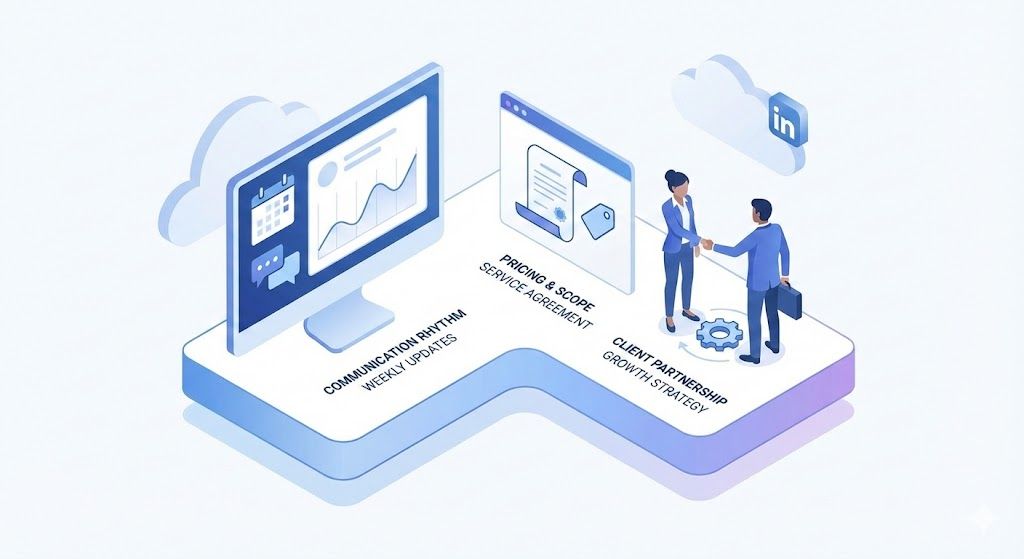
LinkedIn Ads is one of the most powerful B2B lead generation channels available-and one of the most operationally challenging services for a small agency to deliver profitably.
The challenge isn't running the campaigns. Most agency owners who add LinkedIn Ads to their service mix already understand targeting, creative best practices, and Campaign Manager. The challenge is everything that happens around the campaigns: setting the right expectations, pricing the work sustainably, communicating through the slow early months, and proving value when attribution gets murky.
At AgencyAccess, we work with agencies adding paid social services every day. The pattern we see repeatedly: tactical expertise is rarely the issue. Business operations-pricing, onboarding, client communication, scope management-is where engagements succeed or fail.
This guide covers the operational side of running LinkedIn Ads as an agency service: how to sell it, structure it, and retain clients through the unique challenges of B2B advertising.
Key Takeaways
- Minimum contract terms of 4-6 months are essential-the average B2B sales cycle spans 192 days with 60+ touchpoints
- Price LinkedIn Ads retainers at $2,500-7,500/month for small agencies; percentage-of-spend models often create misaligned incentives
- 80% of B2B social media leads originate from LinkedIn, but attribution remains the #1 challenge for 68% of B2B marketers
- Set expectations before signing: LinkedIn CPLs run $50-180 vs. $20-50 on other platforms-this reflects audience quality, not poor performance
- Communication cadence matters: weekly light-touch updates prevent client anxiety during the slow early months
- Quarterly business reviews focused on pipeline influence (not just leads) are what retain clients long-term
Why LinkedIn Ads Requires Different Operational Thinking
Before diving into the operational framework, it's worth understanding why LinkedIn Ads can't be run like your Google or Meta engagements.
The economics are different. LinkedIn CPCs typically run $5-12+ (compared to $1-3 on Meta). Cost per lead ranges from $50-180 depending on your client's industry and targeting specificity. These aren't signs of poor campaign management-they're the cost of accessing decision-makers in a professional context.
The timeline is different. Research from LinkedIn's B2B Institute shows that only about 5% of B2B buyers are actively "in-market" at any given time. The average B2B customer journey spans 192 days and involves over 60 touchpoints. This means LinkedIn Ads is often a long game of building awareness and pipeline influence rather than generating immediate conversions.
Attribution is different. According to Gartner's 2025 B2B marketing survey, 68% of B2B marketers cite correct attribution as one of their biggest challenges. A prospect might see your client's LinkedIn ad multiple times, research the company independently, then convert through a direct visit or branded search weeks later-with LinkedIn receiving zero credit in last-touch reporting.
Why this matters operationally: These realities require longer contracts, different success metrics, more client education, and reporting that tells the full story. Agencies that treat LinkedIn Ads like a performance channel with 30-day ROI expectations will churn clients.
The LinkedIn Ads Advantage: Why the Premium Is Worth It
Despite higher costs, the data supports LinkedIn's value for B2B:
| Metric | Other Platforms | |
|---|---|---|
| B2B social media lead share | 80% | 20% combined |
| Conversion rate vs. average | 2x higher | Baseline |
| Lead generation effectiveness | 277% more than Facebook/Twitter combined | Baseline |
| Cost per lead vs. Google Ads | 28% lower | Baseline |
| Decision-maker reach | 4 in 5 members influence buying decisions | Varies |
Sources: Sprout Social, LinkedIn Marketing Solutions
According to Sprout Social's analysis, 89% of B2B marketers use LinkedIn for lead generation, and 62% confirm it produces leads for their business. The platform's Lead Gen Forms achieve a 13% conversion rate-more than five times the industry average.
The premium pricing reflects premium audience quality. Your operational challenge is helping clients understand this value exchange.
Selling LinkedIn Ads: Packaging and Pricing
Positioning the Service
The clients who succeed with LinkedIn Ads share certain characteristics. Before signing an engagement, qualify for these:
- Sufficient customer lifetime value. If your client's average deal size is under $5,000, the math often doesn't work. LinkedIn Ads typically makes sense for B2B companies with deal sizes of $10,000+ or meaningful recurring revenue.
- A defined ICP. LinkedIn's targeting power is wasted on clients who can't articulate their ideal customer profile. If they can't tell you the job titles, company sizes, and industries they're targeting, they're not ready.
- Realistic timelines. Clients expecting leads in Week 1 will become frustrated clients by Month 2. The right clients understand they're investing in pipeline, not instant results.
Position LinkedIn Ads as a pipeline investment, not a lead faucet. This framing sets you up for the longer runway the channel requires.
Pricing Models That Protect Your Margins
Three pricing models dominate agency LinkedIn Ads work:
Flat monthly retainer ($2,500-$7,500/month for most small agencies) works well when scope is clearly defined. It provides predictable revenue and aligns with the ongoing nature of the work. The risk: scope creep eroding margins if boundaries aren't clear.
Percentage of ad spend (typically 15-25%) scales naturally with client investment but can create misaligned incentives and unpredictable agency revenue. It also doesn't account for the reality that a $5,000/month account often requires similar strategic effort to a $15,000/month account.
Hybrid models combine a base retainer with a smaller percentage of spend above certain thresholds. This provides baseline predictability while capturing upside on larger accounts.
For most small agencies, a flat retainer with clearly defined scope tends to work best. It keeps things simple and focuses conversations on value delivered rather than hours worked.
Contract Terms That Reflect Reality
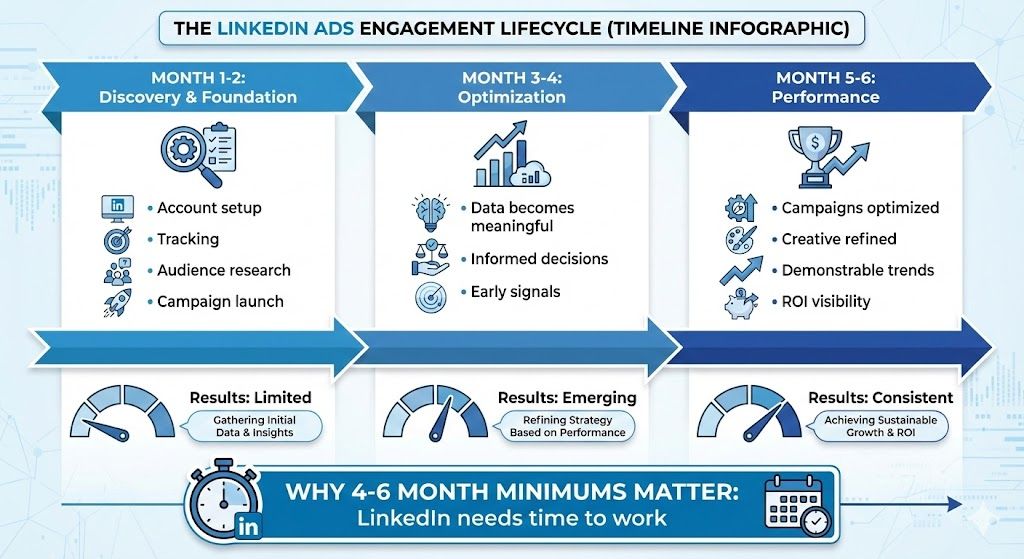
Given LinkedIn's learning curve and longer B2B sales cycles, short-term contracts set both parties up for disappointment. Structure engagements in phases:
Month 1-2: Discovery and foundation. Account setup, tracking implementation, audience research, initial creative development, and campaign launch. Results will be limited-this is about building infrastructure.
Month 3-4: Optimization. Data starts becoming meaningful. You can make informed decisions about audiences, creative, and bidding. Early signals of what's working emerge.
Month 5-6: Performance. Campaigns are optimized, creative has been refined, and you have enough data to demonstrate trends and patterns.
Minimum engagement terms of 4-6 months allow you to actually prove value. Many agencies require 6 months initially, then move to quarterly renewals. Whatever term you choose, make sure your contract language explains why-clients who understand the reasoning are more likely to stay the course during slow early months.
What's Included vs. What's an Add-On
Define clear boundaries upfront to prevent scope creep:
Typically included in a LinkedIn Ads retainer:
- Campaign strategy and planning
- Audience research and targeting setup
- Campaign buildout and management
- Bid optimization and budget management
- Performance monitoring and optimization
- Monthly reporting and analysis
Typically positioned as add-ons:
- Landing page design and development
- Creative production (photography, video, design)
- Copywriting for thought leadership content
- CRM integration and lead routing setup
- Additional platforms (if they want Meta or Google too)
Document these boundaries in your proposal and revisit them during onboarding. When clients ask for items outside scope, you can reference the agreement and offer to quote the additional work-turning scope creep into upsell opportunities.
Setting Expectations Before Day 1
The pre-sale conversation determines whether you'll have a successful engagement or a frustrated client. Cover these topics explicitly before contracts are signed:
Aligning on Success Metrics
"Leads" means different things to different clients. Get specific:
- Are they measuring form fills, MQLs, SQLs, or closed deals?
- What's their current cost per lead from other channels?
- What does their sales team consider a "qualified" lead?
- What's their average sales cycle length?
For clients with long sales cycles (3+ months), measuring LinkedIn's impact on bottom-of-funnel conversions in the first 90 days is unreliable. Agree upfront on leading indicators-engagement rates, lead volume, lead quality scores-that you'll track while pipeline data matures.
The Cost Conversation
LinkedIn Ads sticker shock is real. Don't let clients discover CPL reality after they've signed.
Share benchmark ranges during the sales process: "For B2B SaaS targeting senior decision-makers, we typically see cost per lead in the $75-150 range. This is higher than other platforms, but these leads tend to convert at higher rates and represent larger deal sizes."
According to HockeyStack's 2025 LinkedIn Ads Benchmark Report, LinkedIn delivers an average ROAS of 113% for B2B SaaS-higher than Google Search (98%) or Meta (104%) when measured within standard attribution windows. The higher CPL often yields higher lifetime value.
If a client balks at these numbers, they may not be the right fit-better to learn that now than after two months of frustration.
Platform Learning Curve
Explain that LinkedIn campaigns need time to exit the learning phase and gather optimization data. Setting expectations for a "slow start" prevents panic when Week 1 doesn't deliver a flood of leads.
A simple framing: "The first 30 days are about learning-what audiences respond, what creative resonates, what messaging converts. We'll have early signals, but meaningful optimization happens in Months 2 and 3."
Onboarding: Beyond Just Getting Access
Many agencies treat onboarding as a checklist of permissions to obtain. That's necessary but insufficient. True onboarding sets the foundation for a successful ongoing relationship.
Information Gathering
Before you can run effective campaigns, you need:
Business context:
- Who is their ideal customer? (Titles, industries, company sizes)
- What problems do they solve?
- What differentiates them from competitors?
- What's their sales cycle look like?
- How do leads get routed and followed up?
Technical requirements:
- CRM access for lead routing
- Website analytics access
- Existing creative assets
- Brand guidelines
Historical data:
- Results from previous LinkedIn efforts (if any)
- Performance benchmarks from other channels
- Past creative that performed well or poorly
Solving the Access Problem
The #1 reason LinkedIn campaigns get delayed isn't strategy-it's the "access scramble." Agencies lose days waiting for clients to figure out how to grant the right permissions, add partners to LinkedIn Business Manager, or install the Insight Tag.
This operational friction frustrates clients before the work even begins and delays your time-to-value.
Modern agencies solve this by streamlining the permissions process. Tools like AgencyAccess replace the 10-page PDF how-to guides with a single link that walks clients through granting access to their LinkedIn Ads account, Insight Tag, and other platforms in minutes rather than days.
However you solve it, treat access acquisition as a first-class operational problem. The faster you're actually running campaigns, the faster you can demonstrate value.
The Kickoff Meeting
A structured kickoff meeting transitions the relationship from "sales mode" to "partnership mode." Cover:
Introductions. Who's working on the account? Who's the client's main point of contact?
Goals review. Confirm the success metrics discussed during sales.
Timeline walkthrough. What happens in Week 1, Month 1, Month 3?
Communication cadence. How often will you meet? How should they reach you with questions?
Immediate next steps. What do you need from them this week?
End the kickoff with clarity on both sides. The client should know exactly what to expect and what's expected of them.
Communication Rhythm: What to Say and When
Regular, proactive communication is the difference between clients who trust you through slow periods and clients who start questioning the engagement.
Weekly: Light-Touch Updates
A brief weekly update-even just 3-4 bullet points via email-keeps clients informed without overwhelming them:
- What you worked on this week
- Key metrics snapshot (spend, impressions, clicks, leads)
- What's planned for next week
- Any blockers or needs from their side
During the early "learning phase," these updates are especially important. They show activity and progress even when lead volume is low.
Monthly: Performance Reviews
Monthly calls or detailed reports should cover:
- Performance against agreed KPIs
- What's working and what you're testing
- Recommendations for next month
- Any strategic questions or pivots to discuss
Frame underperformance constructively. "This audience segment isn't performing as expected, so we're reallocating budget to the segment that's showing stronger engagement" is better than defensive explanations.
Quarterly: Strategic Reviews
Quarterly business reviews zoom out from campaign tactics to business impact:
- Pipeline influence and revenue attribution (if data is available)
- Strategic recommendations for the next quarter
- Discussion of budget levels and scope
- Opportunity to identify expansion or upsell potential
These reviews position you as a strategic partner rather than a vendor executing tasks.
Handling the "Why Aren't We Getting Leads?" Conversation
This conversation is inevitable, usually around Week 3-4 of a new engagement. Prepare for it:
Acknowledge the concern. Don't be defensive. "I understand-you're investing significantly and want to see results."
Reiterate the timeline. "As we discussed during onboarding, LinkedIn typically requires 60-90 days before we see consistent patterns. We're on track with where we expected to be at this stage."
Show progress. "Here's what the data is telling us so far-these audiences are engaging, this creative is resonating. We're building the foundation for the results that come in Months 2 and 3."
Provide a forward view. "Here's what we're focused on this month and what I expect we'll see as a result."
If you set expectations properly during sales and onboarding, this conversation becomes a reassurance rather than a confrontation.
Reporting That Retains Clients
For LinkedIn Ads specifically, reporting requires extra care. Standard last-click attribution undersells the platform's contribution, and B2B sales cycles mean conversion data lags significantly.
The attribution gap is real: When LinkedIn engagement data is included in revenue attribution modeling, companies see a 7.7x increase in attribution accuracy, according to research from Swydo. Without proper attribution, agencies risk undervaluing LinkedIn's contribution to pipeline-and losing clients who can't see the ROI.
Metrics That Matter for B2B Clients
Leading indicators (report weekly/monthly):
- Impressions and reach
- Click-through rate and engagement rate
- Cost per click
- Lead volume and cost per lead
- Lead quality scores (if defined)
Lagging indicators (report monthly/quarterly):
- MQLs and SQLs generated
- Pipeline influenced
- Cost per opportunity
- Revenue attributed (when available)
Connecting to Business Outcomes
Clients care about revenue, not impressions. Build reporting that bridges campaign metrics to business impact:
- Show lead-to-opportunity conversion rates
- Track pipeline value influenced by LinkedIn leads
- Compare LinkedIn lead quality to other channels
- Document closed deals that originated from LinkedIn
If your client's CRM can't provide this data, help them set up the tracking. The ability to report on revenue impact-not just lead volume-is often what keeps clients renewing.
Reporting Underperformance Honestly
Campaigns don't always work. When they don't, transparency builds more trust than spin.
"This campaign didn't hit our targets. Here's what we learned, here's what we're changing, and here's what we expect to see as a result." This approach respects the client's intelligence and demonstrates your commitment to improvement.
Scope Management and the "Can You Also..." Problem
Scope creep is the silent margin killer for agency services. LinkedIn Ads engagements are particularly susceptible because the line between "campaign management" and "we need new creative" or "can you fix our landing page" blurs easily.
Setting Boundaries Without Damaging Relationships
When clients request out-of-scope work, respond with helpful clarity:
"Happy to help with that. Since landing page design falls outside our current agreement, I'll put together a quick quote for the additional work. In the meantime, here's what we can do with the existing page to improve conversion rates."
This positions you as accommodating while protecting your margins. Document everything in writing.
Turning Scope Creep Into Revenue
Train yourself (and your team) to see scope expansion as opportunity rather than burden:
- "You need more creative? We offer a creative retainer add-on."
- "Your landing pages need work? We can quote that as a project."
- "You want to add Meta to the mix? Let me show you our multi-platform package."
The best account managers convert 30%+ of scope creep requests into additional revenue.
Retention, Referrals, and Growth
Early Warning Signs
Watch for these signals that a client may be at risk:
- Declining engagement in meetings or calls
- Delayed responses to your communications
- Increased questioning of value or invoices
- New stakeholders asking basic "why are we doing this" questions
- Requests for reduced scope or budget
Address concerns proactively. A 15-minute call to check in on a quiet client is better than being surprised by a cancellation notice.
When and How to Ask for Referrals
The best time to ask for referrals is when you've just delivered clear value-a strong monthly report, a successful campaign launch, or positive feedback from the client.
Keep it simple: "I'm glad things are going well. If you know anyone else who might benefit from what we're doing together, I'd appreciate an introduction."
Many agencies formalize this with referral incentives (a discount on next month's retainer, a gift card, etc.), but often a simple ask after good results is enough.
Expanding Accounts
Satisfied LinkedIn Ads clients are prime candidates for:
- Adding other platforms (Meta, Google, programmatic)
- Expanding LinkedIn scope (Thought Leader Ads, ABM programs)
- Related services (landing page optimization, creative production, CRM setup)
Quarterly business reviews are natural opportunities to discuss expansion. Come prepared with specific recommendations tied to their goals.
Scaling Your LinkedIn Ads Practice
Capacity Planning
How many LinkedIn Ads accounts can one person manage well?
There's no universal answer, but rough benchmarks for a competent media buyer:
- 5-8 accounts: Sustainable with high-touch service and strategic depth
- 10-15 accounts: Manageable with solid processes and some automation
- 15+: Requires junior support, templatized approaches, or reduced service depth
Quality suffers when account managers are stretched too thin. If client satisfaction or retention drops, you've likely hit capacity.
What to Systematize vs. Customize
Systematize:
- Onboarding workflows and checklists
- Reporting templates and schedules
- Campaign naming conventions
- Creative testing frameworks
- Communication templates for common situations
Customize:
- Strategy and audience research
- Creative concepts and messaging
- Client communication and relationship management
- Problem-solving and optimization decisions
Systems free up time for the high-value customized work that clients actually pay for.
When to Hire vs. When to Improve Process
Before hiring, ask: "Is this a capacity problem or a process problem?"
If your team is spending hours on tasks that could be automated or templatized, improve the process first. If you have efficient processes and still can't keep up with demand, it's time to hire.
Making It Work
Running LinkedIn Ads profitably as an agency service comes down to operational discipline: pricing that reflects the true cost of delivery, contracts that allow enough runway to prove value, communication that builds trust through slow periods, and scope management that protects margins.
The tactical side of LinkedIn advertising-targeting, creative, bidding-can be learned from LinkedIn's Marketing Solutions documentation and industry resources. The operational side is what separates agencies that struggle with client churn from agencies that build profitable, long-term relationships.
Start by auditing your current approach: Are your contracts long enough? Is your pricing sustainable? Are you communicating proactively? Are your clients clear on what success looks like and how long it takes?
Small operational improvements compound over time. An agency that retains clients for 18 months instead of 6 months doesn't just earn 3x the revenue-it also reduces the constant pressure to replace churned clients, freeing up energy for better work.
Frequently Asked Questions
How much should agencies charge for LinkedIn Ads management?
Most small agencies charge between $2,500 and $7,500 per month for LinkedIn Ads management, depending on account complexity and service depth. Percentage-of-spend models (typically 15-25%) are less common because a $5,000/month account often requires similar strategic effort to a $15,000/month account. Flat retainers with clearly defined scope tend to work best for predictable margins.
What's a realistic cost per lead on LinkedIn Ads?
LinkedIn cost per lead typically ranges from $50-180 for B2B campaigns, significantly higher than Meta ($20-50) or Google Display. However, LinkedIn's CPL is actually 28% lower than Google Search Ads for B2B, and LinkedIn leads convert at 2x the rate of other platforms. The higher CPL reflects access to decision-makers-four out of five LinkedIn members influence buying decisions at their companies.
How long should LinkedIn Ads contracts be?
Minimum contract terms of 4-6 months are recommended. The average B2B customer journey spans 192 days, and LinkedIn campaigns need 60-90 days to exit the learning phase and gather meaningful optimization data. Short-term contracts set both agencies and clients up for disappointment because results rarely materialize in the first 30-60 days.
Why is LinkedIn Ads attribution so difficult?
B2B buyers rarely convert on first click. They see ads multiple times, research independently, and often convert through direct visits or branded search-with LinkedIn receiving zero credit in last-touch attribution. Gartner research shows 68% of B2B marketers cite correct attribution as their biggest challenge. Agencies should report on pipeline influence and leading indicators, not just last-click conversions.
How many LinkedIn Ads accounts can one person manage?
A competent media buyer can typically manage 5-8 accounts with high-touch service, 10-15 with solid processes and automation, or 15+ with junior support and templatized approaches. Quality and client satisfaction tend to decline when account managers are stretched beyond these thresholds.
Ready to eliminate onboarding friction and get campaigns live faster? Try AgencyAccess free and see how modern agencies streamline client permissions across LinkedIn, Meta, Google, and more.