
Onboarding sets the tone for your entire client relationship. Get it right and you're running campaigns within a week. Get it wrong and you're still chasing Google Ads access three weeks later while your client wonders what they're paying for.
86% of customers say they'd be more likely to stay loyal to a business that invests in onboarding content that welcomes and educates them. That stat is about SaaS, but the principle holds for agencies too - a smooth first experience builds the trust that retains clients long-term.
After helping over 10,000 clients get onboarded through our platform, we've seen what separates agencies with tight onboarding from ones that wing it every time. This is the framework that works.
The best onboarding doesn't just collect information - it proves to the client that they made the right choice.
Phase 1: Before the Contract Is Signed
Good onboarding starts before the ink is dry. During the sales process, you're already collecting information that will matter later - don't let it evaporate.
Set expectations about the onboarding timeline. Tell prospects upfront: "After you sign, we'll send you a link to connect your accounts. Most clients complete it in one sitting. We'll have our kickoff call within [X days] and campaigns live within [Y days]."
Clients who know what's coming move faster than clients who are surprised by requests.
Identify the person with platform access early. The person who signs the contract is often not the person who has admin access to Google Ads or Meta Business Manager. Ask during the sales process: "Who on your team manages your ad accounts and analytics?"
Getting this name early saves you a week of "let me check with my IT person" later.
Document what you'll need access to. Before you even send the contract, know exactly which platforms and permission levels you'll need. A PPC engagement needs different access than an SEO audit. Standardize this per service type so you're not rebuilding the list from scratch every time.
Phase 2: The First 24 Hours After Signing
The window between contract signing and kickoff is when momentum is highest. Your client is excited, engaged, and ready to move. Use that energy.
Send the access request immediately. Don't wait for the kickoff call to start collecting access. Send your onboarding link or instructions the same day the contract is signed - ideally within the hour.
Every day you wait is a day your client's attention drifts.
Collect client context alongside access. While your client is in "setup mode," collect everything you'll need for the kickoff: monthly ad budget, target audience, geographic focus, existing brand guidelines, competitor URLs, business goals.
Collecting this alongside access requests means the client does it all in one sitting instead of across multiple email threads over two weeks.
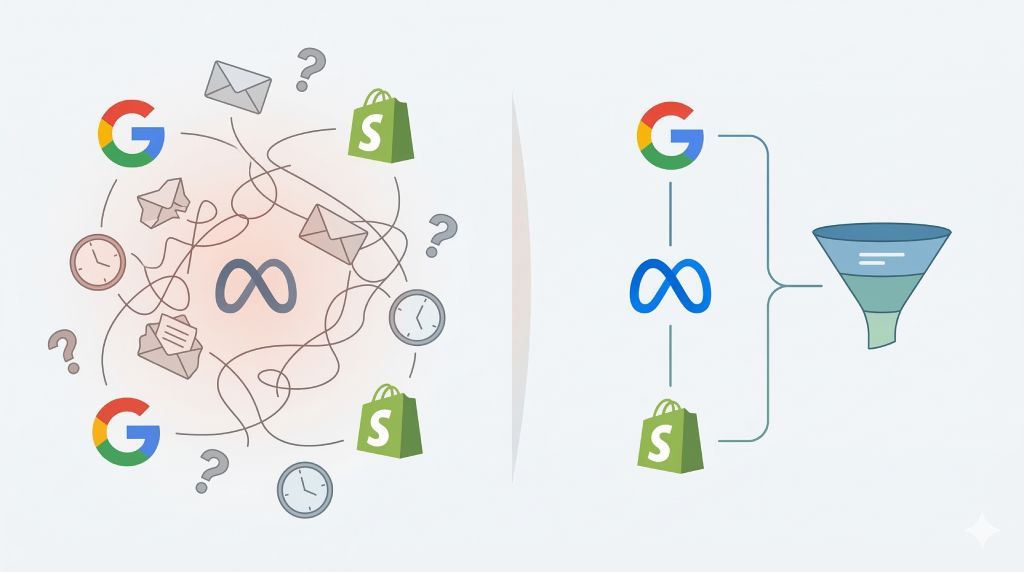
This is where most agencies lose time. Access collection is the single biggest bottleneck in agency onboarding. You send platform-by-platform instructions, the client gets confused by Google's latest UI change, they grant the wrong permissions, and the back-and-forth begins.
Poor onboarding experiences account for 23% of customer churn. Reducing friction at this step has an outsized impact on retention.
Tools like AgencyAccess exist specifically to solve this - your client clicks one link, follows guided prompts for each platform, and you see access appear in your dashboard. Whether you use a tool or do it manually, the key principle is the same: collect access before kickoff, not during it.
Phase 3: The Kickoff Call
If you've done phases 1 and 2 right, your kickoff call is a strategy session, not a tech support call.
Review what you already have. Open the call by confirming: "We've got access to your Google Ads, GA4, Meta, and Shopify accounts. Here's what we're seeing so far."
This immediately signals competence and makes the client feel like they made the right choice.
Align on goals and success metrics. What does success look like in 30, 60, 90 days? What are the KPIs that matter most? This is the conversation your kickoff should be about - not troubleshooting why the client's Meta Business Manager invitation didn't go through.
Agree on communication cadence. How often will you report? Which channel - email, Slack, a portal? Who's the day-to-day contact on their side?
Nail this down now. It prevents the "I haven't heard from my agency in two weeks" anxiety that kills client relationships early.
Set a clear next step with a date. End every kickoff with a specific commitment: "We'll have the account audit ready by Thursday" or "You'll see the first campaign draft by next Monday."
Vague promises like "we'll get started soon" erode trust.
Phase 4: The Handoff to Delivery
The transition from onboarding to execution is where things fall apart at a lot of agencies. The account manager who ran onboarding has all the context in their head, and the delivery team starts from zero.
Create a client brief that travels with the account. After kickoff, document everything in one place: which accounts are connected, what the goals are, what the budget is, what the client's expectations are, and any quirks or preferences that came up in conversation.
This brief should be the first thing the delivery team reads.
Confirm every platform connection before starting work. Don't assume access is complete because the client said "I did everything." Check every platform. Verify permission levels.
The worst time to discover you have viewer access instead of editor access to GA4 is when you're trying to set up conversion tracking on a Friday afternoon.
Set an internal SLA for time-to-first-deliverable. The period between kickoff and first deliverable is when client confidence is most fragile. They've paid, they've granted access, they've had the call - now they're waiting.
Agencies typically spend around 5 hours per client on onboarding - at $50/hour, that's $250 per client in pure setup costs. The faster you can move from onboarding to delivery, the more profitable and trustworthy your agency becomes.
Phase 5: The 30-Day Check-In
Onboarding isn't over after kickoff. The first month is still onboarding in the client's mind.
Proactively share early results. Even if results are preliminary, share what you're seeing. "Here's what we've learned from the first two weeks of data" is far more reassuring than silence.
Ask for feedback on the onboarding experience. A simple "How was the onboarding process for you? Anything we should improve?" does two things: it shows you care about the relationship, and it gives you data to improve the process for the next client.
63% of customers consider the onboarding experience when deciding whether to continue with a service. For agencies, this translates directly: a smooth onboarding experience is one of the strongest predictors of long-term client retention.
Confirm that access is still working. Tokens expire. Permissions get accidentally revoked. Clients add new platforms. Do a quick access check at the 30-day mark to make sure everything is still connected.
The Onboarding Checklist
Here's the condensed version you can adapt for your agency:
Before signing: Identify who has platform access. Document which platforms you'll need. Set onboarding timeline expectations.
First 24 hours: Send access request. Collect intake information (budgets, goals, brand guidelines, competitors). Confirm access receipt.
Kickoff call: Review connected accounts. Align on goals and KPIs. Agree on communication cadence. Set a specific next step with a date.
Handoff: Create a client brief. Verify all platform connections and permission levels. Assign to delivery team.
30-day check-in: Share early results. Ask for onboarding feedback. Verify access is still active.
The Biggest Lever
If you take one thing from this guide: separate access collection from everything else and do it first.
The single biggest reason onboarding drags on is that agencies mix platform access into kickoff calls, email threads, and Slack conversations. Isolate it, automate it, and get it done before the first meeting.
AgencyAccess was built to do exactly this - send one link, collect access to 25+ platforms, and see what's connected in real time. But even if you handle access manually, the principle holds: collect it first, collect it fast, and collect it all at once.