
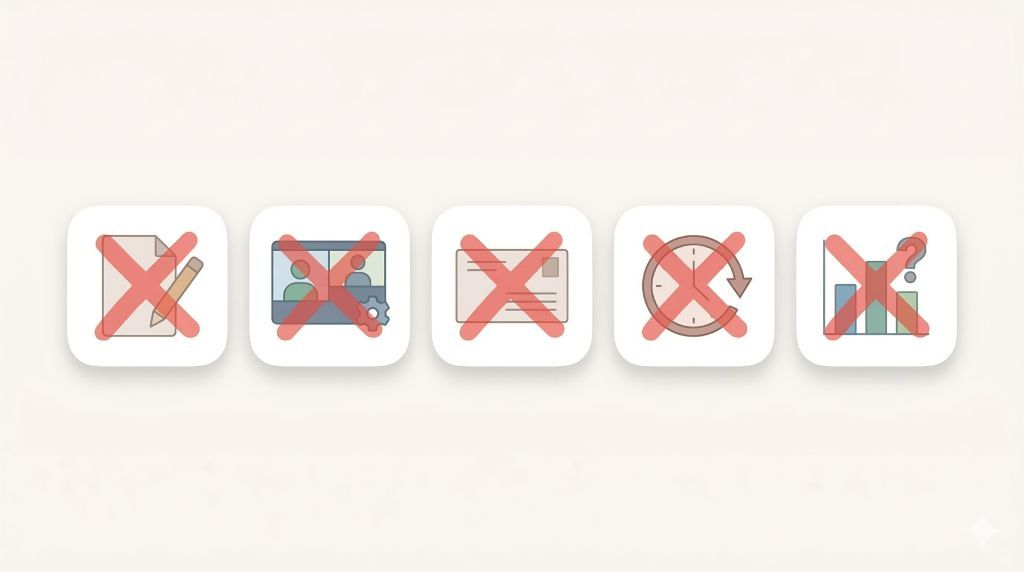
After helping over 10,000 clients get onboarded through AgencyAccess, we've seen the same mistakes come up over and over. Not from bad agencies - from busy ones.
Poor onboarding experiences account for 23% of customer churn. And 63% of customers consider the onboarding period when deciding whether to continue with a service.
Onboarding isn't admin. It's the first test of your client relationship - and most agencies are failing it without realizing.
Here are the five mistakes that cost agencies the most time and trust.
Mistake 1: Starting from scratch with every client
Your account manager just signed a new PPC client. They open their email, find the onboarding thread they sent to a different client two months ago, copy most of it, update a few platform names, and hit send.
The instructions reference a Meta Business Manager UI that changed six weeks ago. The client gets confused at step 3. The back-and-forth begins.
This happens because the process lives in people's heads and email threads - not in a system.
The fix: Standardize per service type
Build one onboarding flow for PPC clients, one for SEO, one for ecommerce. Document which platforms you need, which permission levels, and which intake questions to ask.
The goal isn't rigidity. It's a baseline that works for 90% of clients, with room to adjust the other 10%.
When a new hire joins your team, they should be able to run onboarding on day one by following the system - not by shadowing someone for a month.
A standardized process doesn't make onboarding rigid - it makes it reliable.
Mistake 2: Collecting access during the kickoff call
The kickoff call should be about strategy. Goals, KPIs, timelines, competitive landscape.
Instead, half of most kickoff calls get spent troubleshooting why the client can't find "Access and security" in Google Ads, or walking them through how to add a partner in Meta Business Manager.
This happens because agencies don't separate access collection from the rest of onboarding.
The fix: Collect access before kickoff, not during it
Send your access request the day the contract is signed. By the time the kickoff happens, every account should be connected and verified.
Your first meeting becomes: "Here's what we're seeing in your accounts, here are our initial recommendations, here's the plan."
That's a very different first impression than: "Can you share your screen and click Settings?"
The fastest way to earn a client's confidence is to walk into the first meeting already prepared. Access collection before kickoff is what makes that possible.
Tools like AgencyAccess are built specifically for this - send one link, collect access to 25+ platforms in one flow. But even if you do it manually, the principle is what matters: decouple access from strategy.
Mistake 3: Making onboarding look like an afterthought
Your agency has a polished website, a professional proposal process, and a great sales experience.
Then the client signs and receives a forwarded email with a bullet list of instructions and three Loom links from different dates.
The contrast is jarring. 79% of customers think companies should put more effort into delivering a consistent experience. That applies to agencies too.
The fix: Brand the onboarding experience
Your logo, your colors, your language. If you're sending a link, it should come from your domain or subdomain - not from a tool the client has never heard of.
A client who sees a clean, branded experience thinks: "These people have their act together."
A client who receives a Google Form and a Loom video thinks: "Are they figuring this out as they go?"
Your onboarding experience is the first deliverable your client sees. Treat it like one.
Mistake 4: Manually chasing missing accounts
It's Thursday. Your account manager checks the spreadsheet and realizes the client connected Google Ads and GA4 but never connected Meta or Shopify.
They send a follow-up email. No response. They follow up again Monday. The client replies Wednesday saying "I thought I did that already?"
Another round of instructions. Another week lost.
The fix: Automate reminders and status tracking
Your onboarding system - whatever it is - should tell you what's connected and what's missing without you having to check. And it should remind the client about outstanding items without your team sending manual follow-ups.
This isn't about removing the human touch. It's about saving it for things that need it - the kickoff call, the strategy conversation, the relationship building.
Chasing a client about their Shopify collaborator access is not a good use of your account manager's time.
Agencies spend around 5 hours per client on onboarding admin. Every hour your account manager spends chasing access is an hour they're not spending on strategy, delivery, or client relationships.
Mistake 5: Never measuring onboarding
Ask most agency owners "how long does your onboarding take?" and they'll say something like "a few days, maybe a week."
Measure it - from contract signing to all accounts connected and first deliverable shipped - and the answer is usually two to three weeks. Sometimes longer.
The problem isn't that it takes long. The problem is nobody knows, so nobody fixes it.
The fix: Track two numbers
Time-to-access: how many days between sending the onboarding request and having every platform connected.
Completion rate: what percentage of clients complete onboarding without a follow-up.
These two numbers tell you almost everything. If time-to-access is high, your instructions are probably confusing. If completion rate is low, clients are getting stuck somewhere specific - find out where and fix it.
The key metric to track is "time to verified access" - not just whether a client clicked a link, but whether the access actually works.
If you're not measuring onboarding, you're guessing. And most agencies are surprised when they see the real numbers.
Putting It All Together
The agencies with the best onboarding share five traits:
- They standardize per service type instead of reinventing the process for each client.
- They collect access before kickoff instead of during it.
- They brand the experience instead of forwarding emails and Loom links.
- They automate the repetitive parts instead of manually chasing missing accounts.
- And they measure what's happening instead of guessing.
None of these require a specific tool. But if you want one that handles all five, AgencyAccess was built for exactly this. One link, 25+ platforms, branded experience, real-time dashboard, and the data to know where your onboarding stands.